
The Neurobiology of Language, Speech, and Music
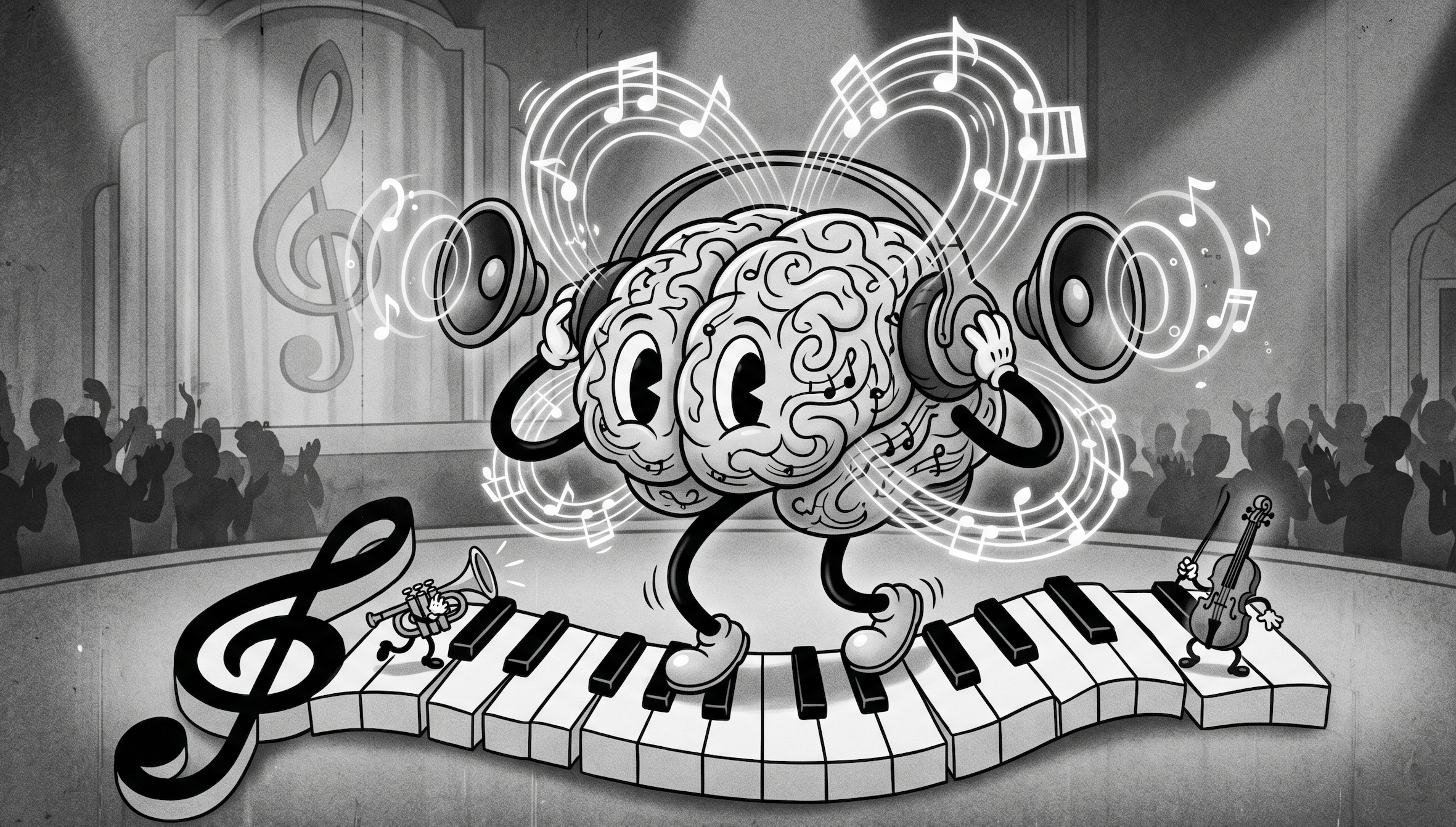
Catchy melodies and spoken conversations might seem very different, but the auditory system handles them in similar ways. In "The Neurobiology of Language, Speech, and Music" by Jonathan Fritz, et al. (2013), featured in Perception: Readings on Vision, Audition, Pain, and Attention (Greenberg & Lenz, 2026), the authors explore how language and music overlap in the brain. They argue that both rely on shared neural mechanisms, but each also has specialized features that help the brain organize complex sounds.
Summary
Fritz, et al. (2013) argue that language and music share a neurobiological foundation, both using similar neural mechanisms. The brain's main challenge is to separate overlapping sounds into distinct sources. Acoustic scene analysis helps by separating voices from background noise, like picking out one instrument in an orchestra. After separating sounds, the brain needs to track the order of events to predict what comes next. Auditory memory works by holding onto sounds just long enough for the brain to compare them to recent patterns. These processes help the brain break up continuous sounds into smaller parts and recognize patterns, whether listening to music or having a conversation.
Language uses clear categories that directly connect to meaning. For example, the difference between /b/ and /p/ changes "bat" to "pat," which completely changes the word's meaning. Spoken language depends on separate units like phonemes, syllables, and words, that refer to things or ideas in the world. Music, on the other hand, organizes sounds by relationships, such as pitch intervals, chords, and rhythms, which set the mood but do not refer to anything outside the music itself. This difference is important because it explains why some people can lose the ability to process music but still understand speech, or vice versa. For instance, people with amusia cannot recognize melodies or notice when someone sings off-key, but they can still understand language. Others with pure word deafness lose speech comprehension yet can still enjoy music. Fritz, et al. use these examples to discuss brain plasticity, evolution, and how the brain organizes sound. These cases show that, even though language and music share some brain resources, they also work independently to some extent.
Critique
Fritz, et al. look at how the brain handles complex sounds by combining ideas from linguistics and musicology with neurobiology. Some brain processes work for both music and speech, but each also has unique features. Language breaks up sounds into phonemes, while music breaks them into notes and chords. Phonemes are categories that connect to meaning, so changing /b/ to /p/ turns "bat" into "pat" and changes the meaning. Musical notes, like C-sharp and D-natural, change the mood or harmony but do not refer to things or actions. This difference helps explain why someone can lose the ability to process music but still understand speech, or the other way around.
Bregman's principles of auditory scene analysis, described in Yantis and Abrams (2017) Chapter 11, help explain how Fritz et al. discuss separating streams in both speech and music. The auditory system needs to break down sound sequences into separate streams. Following a melody uses the same skills as understanding someone talking in a noisy room. Yantis and Abrams explain that the brain groups sounds by harmony and timing, which helps it pick out a clarinet from an orchestra or a friend's voice from background noise. Harmonically related sounds group together, and sudden sounds signal something new. These grouping strategies help the brain solve the cocktail party problem in both language and music. Without them, all sounds would blur together.
The neuropsychological evidence from Fritz, et al. aligns with established classroom instruction on brain damage and language. Lenz explained that damage to certain areas in the left side of the brain can cause aphasia, which affects speech understanding or production. Fritz et al. also discuss congenital and acquired amusia, where people lose the ability to notice pitch differences or recognize tunes, even though their speech perception is normal. Melodic Intonation Therapy shows that using music can help people diagnosed with aphasia speak again by having them sing their words. Some patients who cannot speak normally can still sing the same words. This works because singing uses right-side brain pathways that are not damaged when the left side is affected. The success of this therapy shows that music and language use some of the same motor systems, but they also work separately. These examples show that the brain has separate but sometimes overlapping systems for music and language, which can be used differently in rehabilitation.
Although Fritz, et al. present a thorough model for how speech and music are perceived, one major limitation is that they treat these as only auditory experiences. By focusing just on sound, they miss how important visual information is for understanding both language and music. Yantis and Abrams (2017) point out that visual perception can affect how sounds are located and how speech is understood. The McGurk effect shows that the brain combines what is seen and heard to create new perceptions, especially when the two do not match. For example, when lip movements and speech sounds do not line up, people often hear something different from either input alone. This shows that speech perception is multisensory, not just based on hearing. Watching a speaker's lips helps predict timing and supports speech comprehension in noisy environments. Musicians also use visual cues from conductors or other performers to stay in sync. Lip-reading helps people understand speech in loud environments, and watching a conductor helps musicians keep track of tempo changes.
The chapter raises questions about how these systems develop and evolve. If music can help people recover language skills through Melodic Intonation Therapy, could language-based therapies also help people with amusia? This idea of two-way plasticity has not been fully studied. Additionally, the effects of different sound environments, such as auto-tuned music or synthetic speech, on brain development remain unclear. The model does not predict how these experiences might change the brain. Early music training might change how the brain processes speech, or the two systems might develop separately regardless of environmental input. More research is needed to determine whether critical periods exist when the brain is especially open to change and whether certain therapies are more effective during those times.
Conclusion
The neuropsychological evidence strongly supports the model by Fritz, et al., showing that music and language share some brain processes and have unique features, as seen in cases of amusia and aphasia. However, the model misses an important point by not including multisensory integration. Visual information clearly affects how speech and music are understood, as shown by the McGurk effect and the use of visual signals from performers and conductors. Future research should examine whether therapies can work bidirectionally between music and language, and how exposure to synthetic sounds during development alters how the brain organizes these systems.
References
Fritz, J., et al. (2013). The neurobiology of language, speech, and music. In A. S. Greenberg & P. W. Lenz (Eds.) (2026), Perception: Readings on Vision, Audition, Pain, and Attention. Cognella Publishing.
Lenz, P. W. (2026). Chapter 12: Perceiving Speech and Music [Lecture recording]. Canvas. https://uwm.edu/canvas
Yantis, S., & Abrams, R. A. (2017). Sensation and perception (2nd ed.). Worth Publishers.
